How to choose and when to apply grub control products for your lawn
 Print
Print Email
EmailNot all the grub control products on store shelves will be effective at all times in the season. Here’s how to find an appropriate grub management strategy for your lawn.

Be sure the problem is grubs. Before doing anything, it is important to make sure the problem is grubs. Grubs are beetle larvae in the family Scarabaeidae. When feeding on turfgrass, they attack the root system, making it drought susceptible and easily uprooted. The first signs of grub damage will be thinning, lumpy turf with patches of dead grass. In heavily infested lawns, skunks, raccoons and birds may further damage turf as they search for grubs to eat.
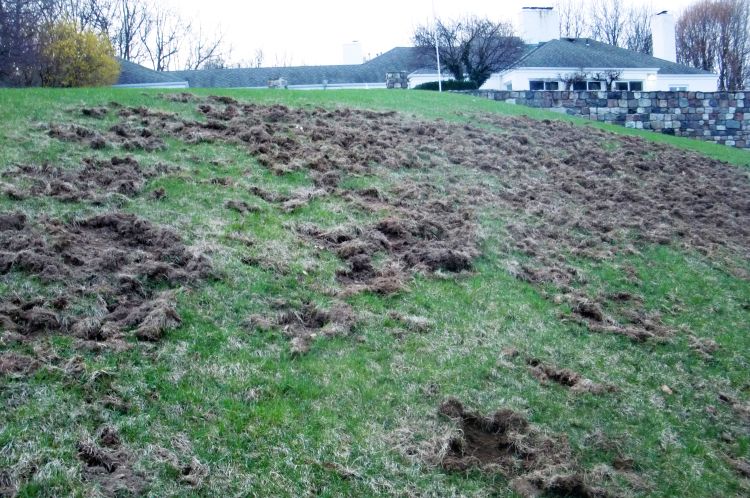
If you see a dead patch, use a shovel to dig up a few 12-inch size samples of turf around the bare spot to a depth of 2 inches and look for 0.75-inch long, C-shaped white grubs. These are most likely the larvae of European chafers (Amphimallon majale) if they are found in lawns without an irrigation system. European chafers can devastate a lawn with little warning because the adult beetles fly at dusk. When they emerge in June and early July to mate and lay eggs, they can easily be overlooked because this activity occurs after sunset. European chafers are generally found in drier turf and their population levels will fluctuate depending how wet or dry the weather was the previous summer.
European chafer grubs can be found in all locations in Michigan’s Lower and Upper Peninsulas. Regionally, European chafers are a much bigger problem than they used to be. In 2002, they were only found in New York, Pennsylvania, Massachusetts, Delaware, New Jersey, Connecticut, New Hampshire, Vermont, Maryland, southern Michigan and eastern Ohio. Now it has spread throughout Ohio, Michigan, Indiana, Wisconsin, Minnesota, Illinois and Washington State. In Canada, it is a problem in Ontario and Vancouver.
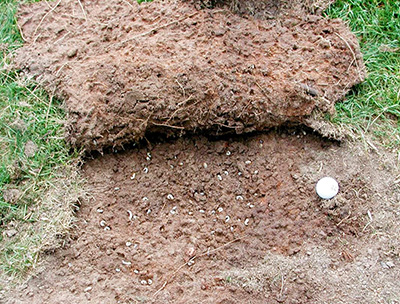
Japanese beetle (Popillia japonica) grubs also feed on turf roots in home lawns, but they are not usually as much of a problem on home lawns as European chafers. Japanese beetles and European chafers lay most of their eggs in July, but Japanese beetles continue laying eggs into August. Japanese beetles like to lay their eggs on irrigated turf like golf courses, athletic fields and highly maintained lawns. They can be abundant in non-irrigated home lawns if we receive frequent rain in July but are scarce in lawns that are very dry in July and early August. Japanese beetle is distributed throughout the Midwest and has been found in isolated locations throughout the Rockey Mountain states and in Washington and Oregon.
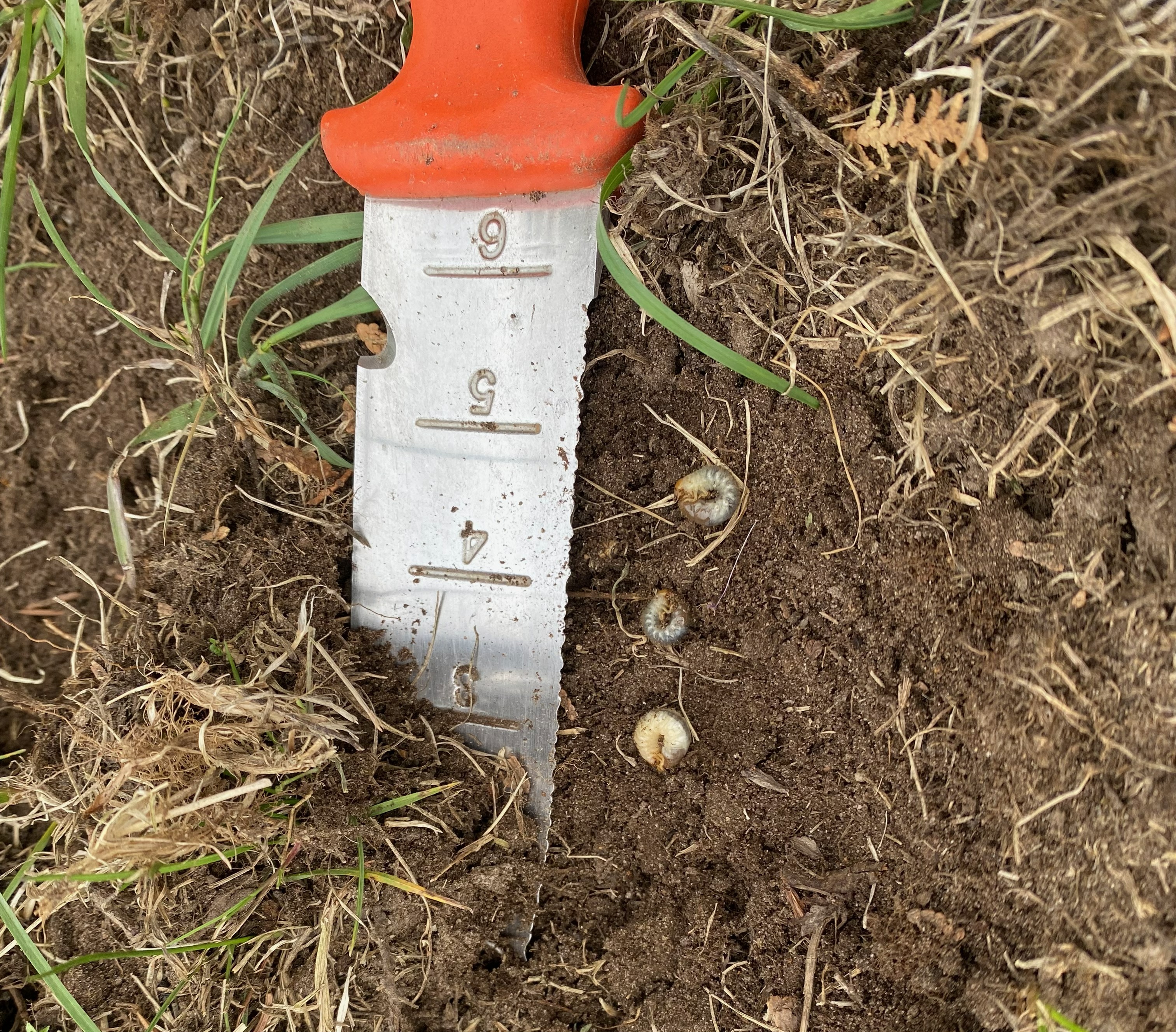
The eggs of both species hatch about 10 days after they are laid. The grubs feed from the beginning of August until late October. By the end of October, they are fully grown. The larvae of both species look almost identical. They spend the winter as large grubs 0.75 inches long, 2-6 inches below the soil surface. When the ground warms up in spring, they resume feeding and can cause damage from the time the grass turns green until they pupate in mid-May. Grub damage may appear in home lawns from mid-September to November or from March to early May. However, for low-maintenance lawns, even if the turf is not killed from grub feeding, the thinned and weakened turf may be prone to weeds and drought stress.
Healthy turf with a few grubs may not need an insecticide. It is important to realize that healthy turf, supported by frequent rain or irrigation, can support a grub population of five or more grubs per square foot with no visible turf damage. In fact, most well-maintained lawns do not have visible damage from grubs. A lawn should be mowed at 3 to 4 inches in height and be properly fertilized for maximum root growth. Finding one or two grubs does not indicate you need to apply a grub control product. The insecticides contained in chemical grub control products are harmful to beneficial insects such as bees and other pollinators. They can also impact wildlife and water quality. Biological control products such as entomopathogenic nematodes (see below) are generally less harmful to beneficial insects. Choose your grub control products wisely and review the product label’s Environmental Hazards section for more information.
If you decide insecticides are needed, check the active ingredient in a grub product. The number of different products available on store shelves can be rather mystifying. The critical issue with any grub control product is the active ingredient. There are many products available, some with the same active ingredients. The active ingredients are usually shown on the bottom right or left of the front of the bag and listed as a percent of composition.
Water the lawn immediately after applying the insecticide. The insecticide must be thoroughly watered into the ground with at least a half-inch of irrigation or rain immediately after the chemical is applied. You can measure how much irrigation is applied by putting out several coffee cups in your lawn and run the irrigation until they fill to a half-inch level above the bottom. Research tests over the last 25 years have clearly shown that watering immediately after application helps to obtain good results.
Use the right rate/amount of product. The label lists the legal rate at which the product can be used. There is little benefit to exceeding this rate, and doing so is also illegal. There are also products for sale that list grubs on the label that do not work for grubs. Insecticides used for grubs can be separated into two groups based on how they work: preventive chemicals and curative chemicals.
Preventive insecticides that will prevent grub damage next fall and following spring
These products are used to prevent future grub problems, not to control the grubs present in the lawn in the spring. They will not work on grubs found in the lawn from the middle of October through the middle of May. However, when applied in June or July they provide excellent protection against the next generation of grubs.
So, if you need to apply preventive insecticide before the grubs are there, how do you know if you need to use an insecticide or not?
If you confirmed grub damage the previous fall or spring, meaning you found 10 or more grubs per square foot, then you may want to use a preventive insecticide to build a dense turf that will be tolerant of grubs. If you have treated the previous year and you do not see evidence of grubs in your lawn, it may be time to stop treating. There is an erroneous philosophy that because we have European chafers and Japanese beetles in the area, it is necessary to treat for grubs every year. This is not true.
Preventive products are the most effective. Products containing imidacloprid, thiamethoxam, clothianidin or chlorantraniloprole are preventive products that work very well on newly hatched grubs present in July, but do not work well for large grubs found from September to May. Except for clothianidin, which does provide some level of curative control, these products will not control grubs in the spring.
There are different recommended timings for application depending on the active ingredient. Although the bag often says apply anytime from May to Aug. 15, it is highly recommended to apply products containing imidacloprid, thiamethoxam or clothianidin into the soil in June or July. If applied in early spring, the pesticide may move through the soil or partially degrade by the time the grubs hatch in late July. If applied too late, preventive products may not be effective as they work best on small grubs.
Preventive products containing imidacloprid, thiamethoxam or clothianidin will consistently reduce grubs if they are applied in June or July and if the lawn is watered with 0.5 inches of irrigation immediately after application. Lawn sprinklers can be used if you do not have an irrigation system.
There is another active ingredient in some insecticides called chlorantraniliprole that will also work in preventing grub problems. It is less water soluble than the other preventive compounds mentioned above, so it can be applied any time after the grass turns green in the spring. Chlorantraniliprole can be applied as early as April and up to mid-July. This chemical can consistently reduce grub numbers and research has shown that applications made before June are more efficacious than June or July applications.
Some of these products come in a granular formulation that is applied with a fertilizer spreader or some products are designed to be mixed with water and sprayed. Also, several products have become available in an attach-to-hose bottle and are automatically mixed with water when applied.
Protecting bees and other pollinators. Withholding insecticide applications for grub control will reduce harm to pollinators and other beneficial insects in your yard. If you are applying a product containing clothianidin, thiamethoxam or imidacloprid, the lawn should be mowed prior to the application so that no weeds are flowering in the lawn when the insecticide is applied. These active ingredients can be toxic to bees if the bees visit flowers that were recently sprayed. Weeds that flower again after mowing are safer than flowers that were sprayed directly with insecticide. However, some of the insecticide is absorbed by the roots and will move into the pollen and nectar if the plants are allowed to flower soon after application. Never allow spray drift or granular spreader drift to adjacent flower beds when applying any lawn insecticide.
Curative insecticides
Curative products can be used to target grubs that are present and actively feeding in your turf. These products generally have short-term impacts and may not be as effective as the preventive treatments mentioned previously.
Entomopathogenic nematodes (EPNs) are a biological insecticide for grubs that can be purchased and sprayed in water using conventional pesticide application equipment. One commercially available EPN species, Heterorhabditis bacteriophora, for example, can be used to target grubs by applying it to the soil when grubs are present. EPNs must be watered in following application, and control will be improved if the treated soil remains moist for several days following application. Full instructions for how to use EPNs successfully against turf pests will be contained on the product label. The nematodes seek out the grubs in the soil and kill them within a few days after application. Several species of EPNs are available for purchase in Michigan, but not all of them will be effective against grubs in your lawn. Check the product label and consult with your supplier to ensure you are purchasing a species with activity against grubs in turf.
In addition to clothianidin discussed previously, there are two chemical insecticides, carbaryl and trichlorfon, that are considered curative treatments. They are short-lived compounds that kill all life stages of grubs. These two insecticides are the only options if high numbers of grubs are found in fall and in spring before early May. Previous research at Michigan State University indicates they will kill 20–80% of grubs when applied in September or 20–55% when applied in late October. They are not as effective as the preventive compounds in reducing grub numbers. The brand Sevin was recently purchased by GardenTech and carbaryl was replaced with the active ingredients bifenthrin and zeta-cypermethrin, which are not effective for controlling grubs. At garden stores and large retailers, it now appears difficult to find products containing carbaryl, thereby further limiting curative grub control options.
Consider carefully whether it would be best to wait and apply a preventive later. If the need should arise to use a curative compound, make sure to keep the infested lawn watered and fertilized and treat the area again with a preventive application the next summer or the problem will likely reoccur in the fall or following spring. Current research also shows that watering with 0.5 inches of irrigation immediately after the application is essential to get effective results from these insecticides. As with the preventive products, lawns should be mowed immediately before applying carbaryl or trichlorfon to protect bees.
Do not apply any curative chemical insecticides in the spring after May 15 as grubs stop feeding in late May as they prepare to pupate. Entomopathogenic nematodes can be applied any time grubs are present in the top few inches of soil (approximately April – October) but will be most effective in Michigan, if applied in late summer.
Insecticides that DO NOT work on grubs
Do not use products containing only lambda-cyhalothrin, gamma-cyhalothrin, bifenthrin, deltamethrin, cyfluthrin or permethrin for grub control. Products containing only these ingredients will not work for grub control because the active ingredient binds with organic material and will not move down to where the grubs are feeding. These products work well for above-ground feeding insects that live on the grass leaves or soil surface, but not for insects that feed on the roots.
There are several products on the market that contain a combination of one of the preventive compounds and one of the above listed insecticides that “do not work on grubs.” The preventive ingredient will make it an effective choice for grub control.
A summary for successful grub control
- Sample your lawn to confirm the presence of grubs before making management decisions.
- Check the bag or bottle to determine what active ingredient the product contains.
- Do not use products containing only lambda-cyhalothrin, gamma-cyhalothrin, bifenthrin, deltamethrin, cyfluthrin or permethrin for any phase of grub control.
- Do not use preventive compounds such as clothianidin, thiamethoxam or imidacloprid in the spring. Use them in June or July to control grubs that would be damaging turf in the fall. Applying them too early will allow some of the chemical to leach through the turf or break down to the point that not enough insecticide will be there in July to control grubs.
- The preventive compound chlorantraniliprole should ideally be applied in April or May to control grubs that would be damaging turf in the fall as it will take longer for the material to move to where the grubs will be feeding in July.
- To kill grubs in the spring or fall, use carbaryl or trichlorfon.
- Always wear rubber gloves and rubber boots when applying insecticides to turfgrass.
- Make sure to irrigate the lawn with at least 0.5 inches of water* and allow the grass to dry before allowing anyone or pets into the treated area. Irrigation is essential for the chemical to be most effective.
- Store insecticide products in a locked cabinet not accessible to children.
- Proper fertilization is important to prevent and allow the lawn to recover from grub damage.
- Mow lawns immediately before applying an insecticide to remove weed flowers and protect bees.
- Make a regular practice of mowing your yard with the mower on the highest setting (3.5–4 inches).
*What is 0.5 inches of irrigation? A half-inch of irrigation is when lawn sprinklers are run until a container like a coffee mug, or several mugs, fills to a level 0.5 inches up from the bottom of the cup.
Example grub control products on store shelves
The following is a short list of products currently being sold for grub control in stores checked in the Mid-Michigan area. An online search indicates there are other products that will be available at other stores. Check the active ingredients and pests controlled before applying any pesticide to your lawn for grub control. Always read and follow all label directions to ensure the product’s effectiveness and to protect the safety of yourself, pets and wildlife.
This list is for educational purposes only. It is not a comprehensive list and presence on this list does not imply endorsement by Michigan State University Extension or bias against those not mentioned.
Example preventive products
- Scotts Grub-Ex – Granular
chlorantraniliprole 0.08%
Apply between April 1 and May 30 (no later than July 15) for best results. - BioAdvanced Season-Long Grub Control – Granular
imidacloprid 0.25%
Apply between June 1 and July 15 for best results. - BioAdvanced Season-Long Grub Control and Turf Revitalizer – Granular
imidacloprid 0.25% and a low fertilizer rate (6-0-1)
Apply between June 1 and July 15 for best results. - Menards Premium Granular Lawn Grub Killer
imidacloprid 0.25%
Apply between June 1 and July 15 for best results. - BioAdvanced Complete Insect Killer Liquid attach-to-hose-bottle
cyfluthrin 0.36% and imidacloprid 0.72%
Apply between June 1 and July 15 for best results. - BioAdvanced Complete Insect Killer Granules – Granular
cyfluthrin 0.05% and imidacloprid 0.15%
Apply between June 1 and July 15 for best results.
Example curative products
- BioAdvanced 24 hr Grub Killer Plus – Granular
trichlorfon 9.3%
Apply in spring or fall to active grubs.
Products that will NOT kill grubs
- GardenTech Sevin Insect Killer Lawn Granules - Granular
zeta-cypermethrin 0.029% and bifenthrin 0.115% - Spectracide Triazicide Insect Killer for Lawns - Granular
gamma-cyhalothrin 0.05%
This work is supported by the Crop Protection and Pest Management Program [grant no 2024-70006-43569] from the USDA National Institute of Food and Agriculture. Any opinions, findings, conclusions, or recommendations expressed in this publication are those of the author(s) and do not necessarily reflect the view of the U.S. Department of Agriculture.