


Saturated Buffer
For the pdf version of this bulletin, click here.
1. Overview of saturated buffers
A saturated buffer is a conservation drainage practice that helps reduce nitrate loss from subsurface-drained farmland. In this system, some of the water from the tile drain is rerouted into perforated pipes running along the ditch bank, buried under a vegetated buffer strip. Water exits the perforated pipes and slowly moves through the soil of the buffer strip, where nitrate is removed by a natural process called denitrification before reaching the ditch (Figure 1). Denitrification is the microbial conversion of nitrate into a harmless nitrogen gas.
A saturated buffer system combines three components (Figure 1):

(1) Controlled drainage, which regulates how much water leaves the field through the tile drains.
(2) Subsurface buffer flow, which treats the diverted drainage water as it slowly moves through the buffer soil.
(3) Buffer strip, which helps reduce and treat surface runoff.
This bulletin shares results from a study (Ghane et al. 2025) comparing a field with a saturated buffer to a similar field with free drainage. The side-by-side paired-field setup gave a clearer picture of saturated buffer performance and helped isolate the effects of subsurface buffer flow and controlled drainage.
2. Performance and field slope suitability
Based on 2023–2024 results, the saturated buffer system reduced annual drainage discharge and nitrate load by 49% and 66%, respectively, in a field with a 1.1% slope (Figure 2).
While some existing guidelines recommend field slopes of 2-8% for saturated buffer suitability, our research showed flatter fields can also be highly effective. These results, measured directly against a control field, demonstrate that saturated buffers can provide measurable water-quality benefits on fields with slopes as low as 1%, supporting their broader use.

3. Controlled drainage and subsurface buffer flow
3.1. Roles of upstream- and middle-chamber weirs
The upstream- and middle-chamber weirs serve different functions in a saturated buffer system:
Upstream-chamber weir: Regulates drainage discharge as a controlled drainage component. In this process, raising the water level in the upstream chamber raises the water table near the field edge, forcing water out through the perforations in both the collector main and laterals, thereby increasing lateral seepage. Under these conditions, these pipes function as additional distribution pipes, expanding the treatment area and enhancing nitrate removal.
Middle-chamber weir: Controls the hydraulic head that drives drainage water through the distribution pipes and into the buffer soil, providing the subsurface buffer flow component.
3.2. Contributions of controlled drainage and subsurface buffer flow
Based on 2023–2024 results, the controlled drainage component reduced 53% of the total nitrate load, while the subsurface buffer flow component reduced 13% (Figure 3). These findings highlight the important contribution of upstream-chamber weir management to saturated buffer performance.
3.3. Two- versus three-chamber structures
A two-chamber control structure can provide functions similar to those of a three-chamber structure. In a two-chamber configuration, the upstream chamber performs the functions of both the controlled drainage and subsurface buffer flow components.

4. Cost-effectiveness
Based on 2023–2024 results, controlled drainage alone was more cost-effective in removing nitrate at $0.22/lb-N, compared to $0.33/lb-N for the full saturated buffer system.
Because the subsurface buffer flow component provided a smaller nitrate reduction, its added cost reduced the overall cost-effectiveness of the system. In this analysis, the field was already equipped with a buffer strip that requires no additional cost. Further research is recommended at other sites.
5. Weir setting and hydraulic performance
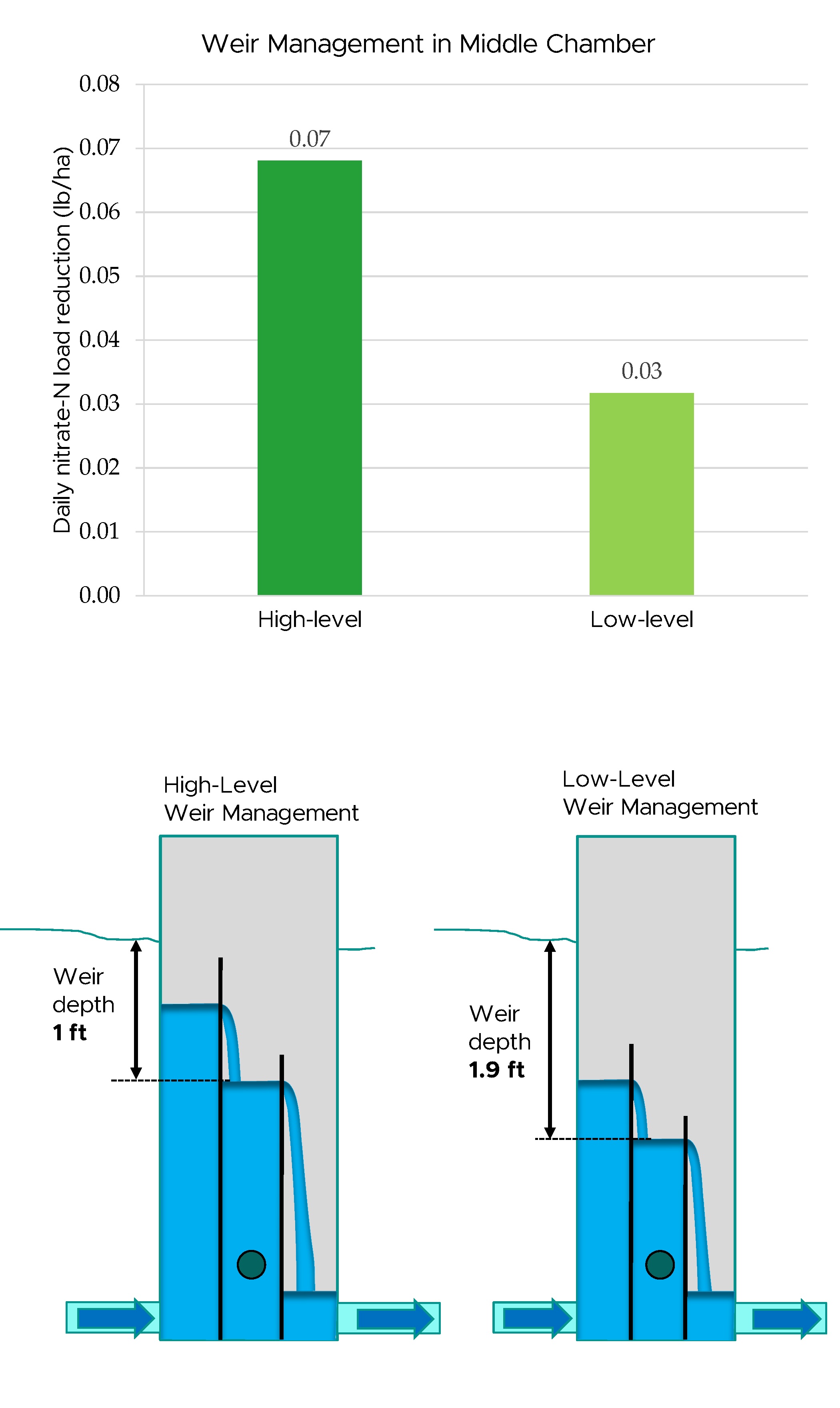
The middle-chamber weir setting affects the hydraulic head available to divert drainage water into the buffer soil.
At the study site, setting the weir 1 ft below the ground surface resulted in an average nitrate-N load reduction of 0.068 lb/ac per day, 115% greater than when the weir was set 1.9 ft below the ground surface (Figure 4). The higher weir setting maintained a greater hydraulic head, increased seepage into the buffer, and increased nitrate load reduction.
6. Preventing backflow with distribution pipe design and weir setting
A positive grade in the distribution pipe, combined with a low weir setting, can cause water to flow from the buffer back into the control structure rather than from the distribution pipe into the buffer soil. Raising the weir increases hydraulic head and can prevent this backflow.
Design Tip 1
If distribution pipes are installed with a positive grade to allow sediment flushing, maintain a high weir setting during normal operation to prevent backflow into the structure. Lower the weir only during flushing periods (Figure 5). Alternatively, install distribution pipes at zero grade (on contour) to prevent backflow and maximize distribution pipe length.

Design Tip 2
Avoid dropping the distribution pipe to the bottom of the control structure (Figure 6). Connect the distribution pipe near its original depth whenever possible. Dropping the pipe increases the potential for backflow when the weir is lowered for trafficability. If a drop is unavoidable, maintain a sufficiently high weir setting during normal operation to minimize backflow.

7. Apparent vs. actual performance
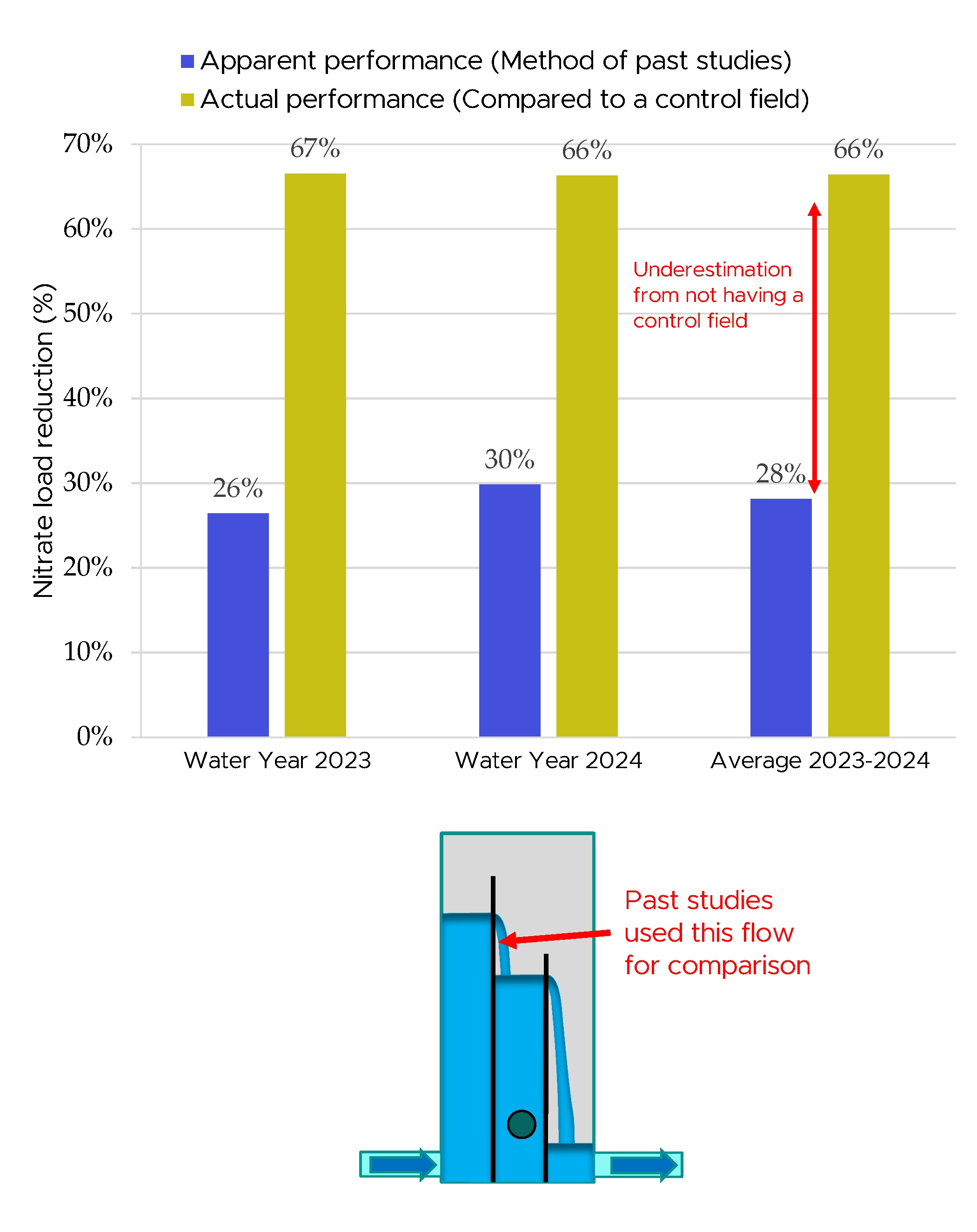
To compare apparent and actual performance, we first applied the method from earlier studies, which calculated performance based on load reduction relative to the water flowing over the upstream chamber (Figure 7). We then calculated actual performance using a free drainage control field.
Our study found:
• Actual nitrate-N reduction: 10.9 lb/ac per year
• Apparent nitrate-N reduction: 2.8 lb/ac per year
The earlier method underestimated saturated buffer performance because the flow over the upstream chamber had already undergone nitrate reduction due to reduced discharge from controlled drainage (see Ghane, 2025). In other words, some nitrate removal occurs before water enters the subsurface buffer flow component.
This additional nitrate removal associated with upstream-chamber weir management helps explain why actual saturated buffer performance was greater than previously reported.
We recommend that future studies use a paired-field design to more accurately evaluate performance.
8. Design and management implications
• Considering the combined impact of controlled drainage and the subsurface buffer flow, saturated buffers are more effective than previously reported.
• Saturated buffers can provide measurable water-quality benefits on fields with slopes as low as 1%.
• Upstream-chamber weir management contributes to nitrate load reduction through controlled drainage and enhanced lateral seepage from perforated pipes.
• Maintain a high weir setting during normal operation to increase hydraulic head and reduce backflow, particularly when distribution pipes are installed on a positive grade.
Acknowledgement
This work was partly funded by the Michigan Department of Agricultural and Rural Development (791N7700580) and the Classic Conservation Innovation Grant (USDA-NRCS-NHQ-CIG-20- GEN0010808) from the US Department of Agriculture’s Natural Resource Conservation Service.
Expert Reviewed
This Extension bulletin has been peer reviewed by external experts.
References
Ghane, E., AbdalAal, Y., Tehrani, A. (2025). Paired-field evaluation of a saturated buffer reveals significant water-quality benefit through upstream weir management. Agricultural Water Management. 318, 109664. https://doi.org/10.1016/j.agwat.2025.109664
Ghane, E. (2025). Controlled drainage beyond flat fields (E3536). Michigan State University Extension Bulletin. www.canr.msu.edu/drainage
 Print
 Email