


About Metacoupling
Understanding human-nature interactions across space
Humans and nature interact everywhere. People depend on land, water, forests, wildlife, climate, food systems, energy, and many other natural resources. At the same time, human actions reshape nature near and far. As the world becomes more populated, more connected, and more rapidly changing, these human-nature interactions are becoming more complex, faster, and more consequential.
For a long time, many of these interactions were studied separately. Researchers often focused on one place, one resource, one species, one community, or one environmental issue at a time. But today’s sustainability challenges rarely stay within one boundary. A decision made in one place can affect people, economies, species, and ecosystems somewhere else. Local actions can have regional and global effects. Distant trade, migration, tourism, disease spread, conservation, development, investment, and information flows can reshape both human well-being and the natural world.
Metacoupling framework was developed to help understand these connected systems more holistically.
What is metacoupling?
Metacoupling is an integrated concept and refers to human-nature interactions within a system (e.g., place such as city or nation), between adjacent systems, and across distant systems.
It brings together three types of couplings:
- Intracoupling refers to human-nature interactions within a system.
- Pericoupling refers to human-nature interactions between adjacent systems.
- Telecoupling refers to human-nature interactions between distant systems.
Together, these three forms of coupling help us see both the details and the big picture. (Telecoupling and pericoupling constitutes “intercoupling”.)
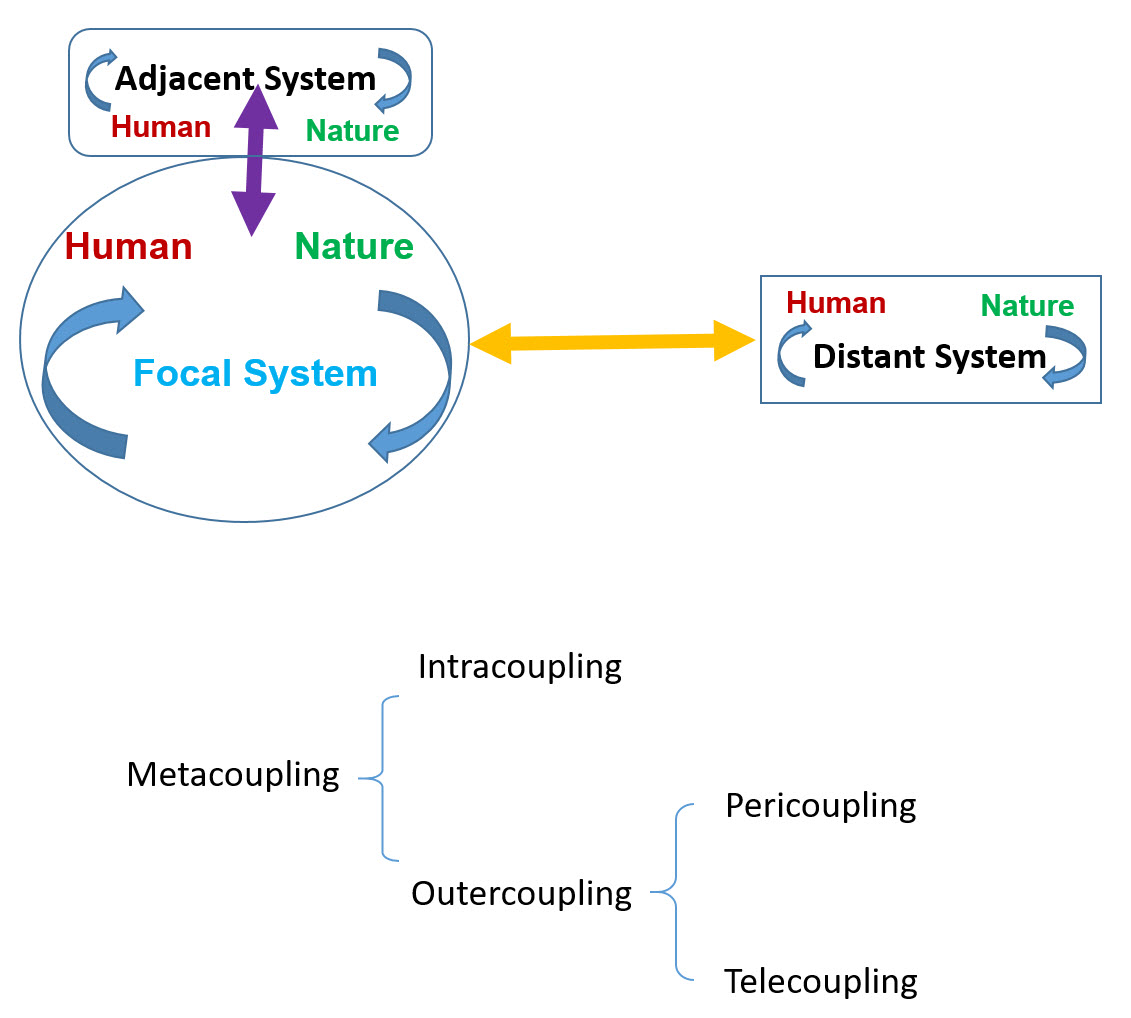
Fig. 1. (Top) A schematic diagram illustrating a focal coupled human and natural system, an adjacent system, and a distant system, as well as their interactions (indicated by arrows). (Bottom) Metacoupling consists of intracoupling and intercoupling, which in turn includes pericoupling and telecoupling. (From Liu 2017).
Why “meta”?
The “meta” in metacoupling reflects the need to look beyond one single system or one single connection. A local environmental issue may involve local communities, neighboring regions, national policies, international markets, global consumers, distant ecosystems, and many different flows of people, goods, money, information, energy, species, and environmental impacts.
Metacoupling Framework
Metacoupling framework provides a language and architecture for asking how people and nature are connected across space, how flows move among systems, and how those connections affect sustainability, livelihoods, ecosystems, and human well-being, etc.
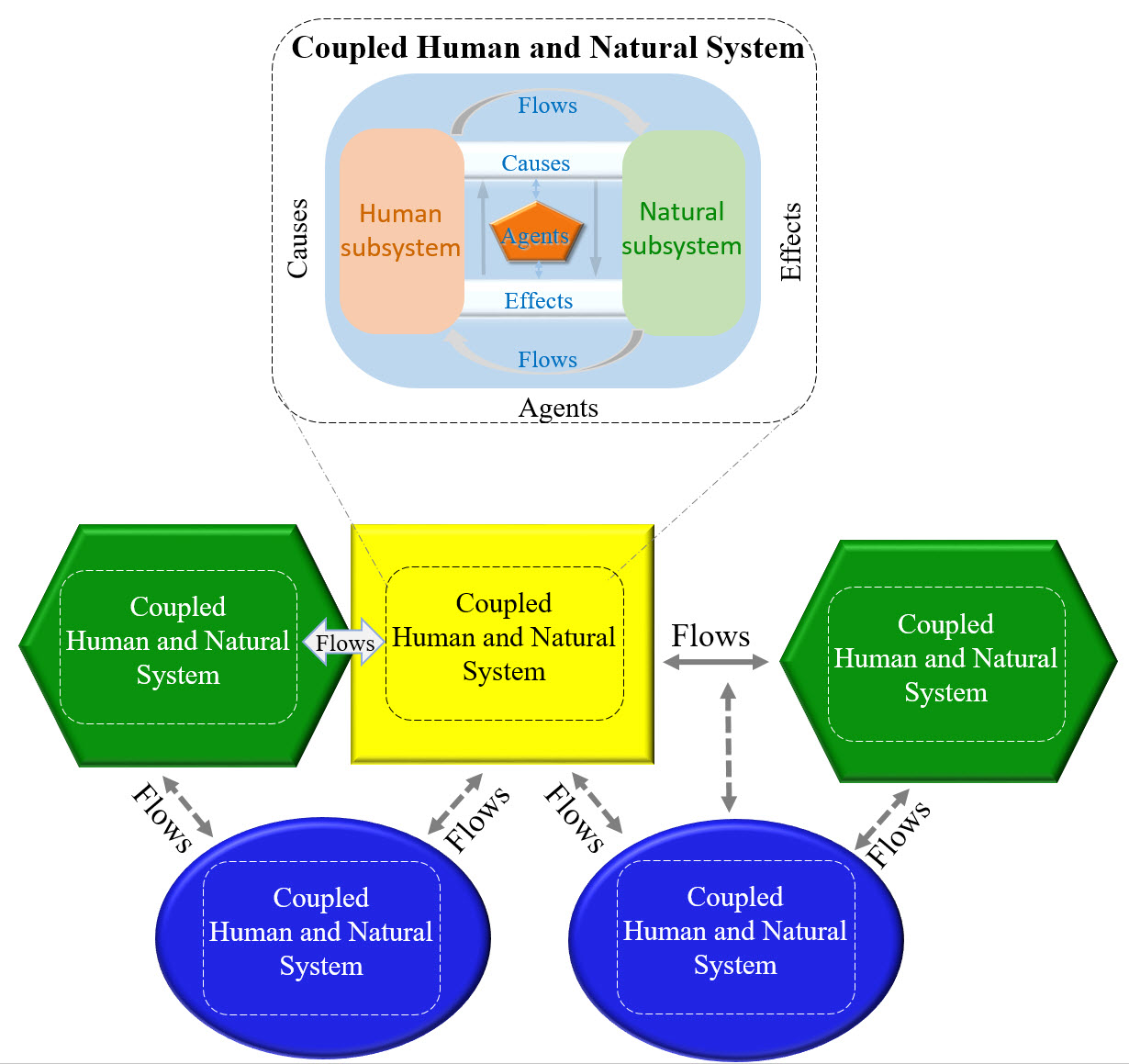
Fig. 2 General conceptual framework of metacoupling. It shows five major components and interrelationships—systems (sending systems that send flows out, receiving systems that receive flows, and spillover systems (e.g., those that are affected by interactions between sending and receiving systems), flows (movements of information, energy, matter, people, organisms, etc), agents (decision-making entities), causes (reasons behind the flows), and effects (consequences of the flows). Letters i, p, and t within parentheses after causes, effects, agents, and flows refer to intracoupling, pericoupling, and telecoupling, respectively. There may be three corresponding types of spillover systems. (From Liu 2017).
Metacoupling framework helps connect various pieces. It encourages us to ask questions such as:
- How do human and natural systems interact within a system?
- How do adjacent systems influence one another?
- How do distant systems become connected through trade, migration, tourism, conservation, investment, or other flows?
- How do different types of human-nature interactions mentioned above amplify or offset each other?
- What are the environmental, social, economic, and political effects of these interactions? (e.g., Who benefits and who suffers?)
- How do feedbacks or spillover effects emerge?
By looking across local, adjacent, and distant systems at the same time, metacoupling framwork helps reveal connections that might otherwise be overlooked.
How metacoupling framework builds on telecoupling framework
Telecoupling framework focuses on socioeconomic and environmental interactions over distances. It has been used to study issues such as international trade, species invasion, migration, foreign investment, fisheries management, biodiversity conservation, land use, and global sustainability.
Metacoupling framework expands this view.
Distant connections are important, but they are only part of the story. Human-nature interactions also occur within systems and between adjacent systems. Furthermore, these different types of interaction interact with each other – e.g., amplify or offset. Metacoupling framework brings these interactions together so that researchers and decision-makers can better understand how local, regional, and global processes interact.
In this way, telecoupling framework is one part of the broader metacoupling framework.
A simple example: giant pandas and people
Giant pandas offer a helpful way to understand metacoupling.
In Wolong, China, pandas and people share a landscape. Local activities such as farming and fuelwood collection are examples of intracoupling.
But Wolong is also connected to nearby places. Girls from adjacent counties move into Wolong after they get married with boys inside Wolong. Wild giant pandas may also move out of the Wolong to the surrounding landscapes because there is no fence around the nature reserve. These interactions between nearby places are examples of pericoupling.
Pandas also connect Wolong to distant parts of the world. Through panda loans, zoos, international diplomacy, tourism, public education, merchandise, transportation, bamboo supply, and global public interest, pandas create relationships between China and faraway countries and communities. These long-distance connections are examples of telecoupling.
Metacoupling framework brings all of these interactions under one structure. It helps us understand not only the pandas and people in one system, but also the nearby and distant systems connected to them.
Why metacoupling framework matters
Many sustainability challenges are connected across space. Climate change, biodiversity loss, food security, land-use change, water scarcity, migration, tourism, supply chains, conservation, and economic development all involve interactions among human and natural systems.
Metacoupling framework helps researchers, policymakers, educators, and communities better understand these interactions. It can reveal hidden connections, unintended consequences, trade-offs, feedbacks, and opportunities for more sustainable decisions.
For example, a conservation policy may protect forests in one place while shifting deforestation somewhere else. A trade relationship may support livelihoods in one region while creating environmental pressure in another. Tourism may bring income to one community while affecting neighboring communities, wildlife, infrastructure, and distant consumers. These are not isolated events. They are parts of metacoupled human and nature systems.
By studying these interconnections together, metacoupling framework supports more integrated thinking and more effective sustainability solutions. For example, the panda habitat in Wolong and across the panda's distribution range has shifted from long-term destruction to recovery, and the panda was removed from the International Union for Conservation of Nature's endangered species list in 2016.
 Print
Print Email
Email