


Spring PLP 894 Seminar featuring Sanju Bijarniya
April 13, 2026 1:30PM - 2:30PM
Room PSSB 271 (PSM conference room) See complete schedule here
Characterization of Pseudomonas syringae Isolates from Blueberry Stem
Blight through Investigation of Virulence Factors and Polymicrobial
Disease Interactions
Sanju Bijarniya, Daniel Maddock, Laely Bishop, Timothy Miles, Michelle Hulin, Department of
Plant, Soil and Microbial Sciences, Michigan State University, USA
ABSTRACT:
Blueberry bacterial stem blight threatens Michigan's $530 million blueberry industry, yet
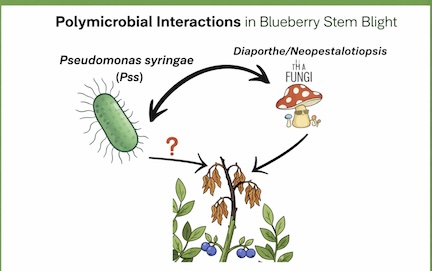
pathogenicity mechanisms remain poorly understood. We hypothesized that Pseudomonas
syringae pathovar syringae (Pss) functions within a polymicrobial disease complex rather than as
a single pathogen. Whole-genome sequencing of 60 Pss isolates from Michigan blueberries
revealed that 80% produce phytotoxins (e.g., syringomycin and syringopeptin) and have an ice
nucleation gene (e.g., inaZ). Copper susceptibility screening using drop-plate assays demonstrated
that most isolates exhibit moderate copper resistance, with 70% growing at 1.4 mM CuSO₄.
Pathogenicity assays on Michigan blueberry cultivars (i.e. Legacy, Jersey Rubel and Blueray) and
cherry (i.e. Coral Champagne) leaves demonstrated host-dependent virulence differences.
Preliminary co-inoculation results indicated that lesions were larger when Pss was combined with
fungi in the genus Neopestalotiopsis than when Pss was inoculated alone. This synergistic
interaction suggests Pss toxins enhance disease severity in mixed infections. To identify specific
virulence mechanisms, we are generating targeted deletion mutants of key virulence genes
including phytotoxin genes (syrB, sypA), the ice nucleation gene (inaZ), and the T3SS hrcC gene
using scarless mutagenesis. Phenotypic evaluation through repeated plant inoculation assays will
reveal which bacterial factors drive disease progression. This research directly addresses whether
Pss is a primary pathogen, opportunistic colonizer, or critical synergistic partner in blueberry stem
blight, providing actionable insights for sustainable disease management in Michigan fruit
production.
 Print
Print Email
Email