FDA Announces “No Artificial Colors” Enforcement Discretion
 Print
Print Email
EmailThe FDA has informed food manufacturers that the agency will exercise enforcement discretion to allow “No artificial colors” and similar claims in many situations. Prudent manufacturers will continue to comply with the law until it is revised.
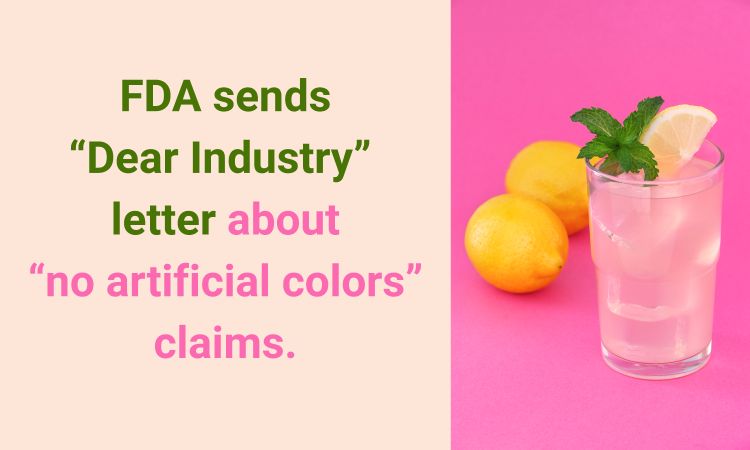
The Food and Drug Administration (FDA) has sent a “Dear Industry” letter informing food manufacturers that the agency will exercise enforcement discretion to allow “No artificial colors” and similar claims if artificial color is added, so long as it is not an FD&C certified color. “Enforcement discretion” means that the FDA plans to take no action for violation of the law should a firm use the claim “no artificial color” to signal the absence of FD&C certified color.
The FDA Commissioner states that the purpose of this change is to facilitate the transition away from FD&C-certified colors. No mention is made of a plan to revise the law. More notable is that no determination is made that such “no artificial” claims are no longer considered misleading, only that the FDA will not prosecute them under section 403(a)(1) of the Federal Food, Drug, and Cosmetic Act (FDCA), the prohibition of false or misleading labeling.
There is a long-standing rule that any color added to a food that is not a normal part of that food is artificial coloring (21 C.F.R. § 101.22(a)(4)). For example, beet juice added to produce pink lemonade is artificial color; carmine added to strawberry yogurt is artificial color. Prudent manufacturers will continue to comply with the law until it is revised (or if it is). The FDA’s enforcement policy can change back in the little time it takes to write a new letter. Revising labels can be much more time-consuming and costly.
Moreover, the FDA’s discretion in enforcing violations of 403(a)(1) of the FDCA provides no shield against lawsuits by competitors, consumers, or states under other laws for what may be found to be false or misleading.
Learn more about food regulations with MSU's online course Food Laws and Regulations in the United States.
The Institute for Food Laws and Regulations (IFLR) at Michigan State University offers graduate degree and continuing education programs designed specifically for food industry professionals. All courses are delivered 100% online and asynchronously, allowing students to manage their studies alongside work and personal responsibilities. Students have the option to pursue a certificate in U.S. or international food law, or work toward a Master of Science in Food Regulatory Affairs. Some students begin by enrolling in a single course to address a specific challenge in their workplace and choose to continue their studies from there.