


Michigan sees a dramatic increase in dairy production
 Print
 Email
What’s behind these trends?

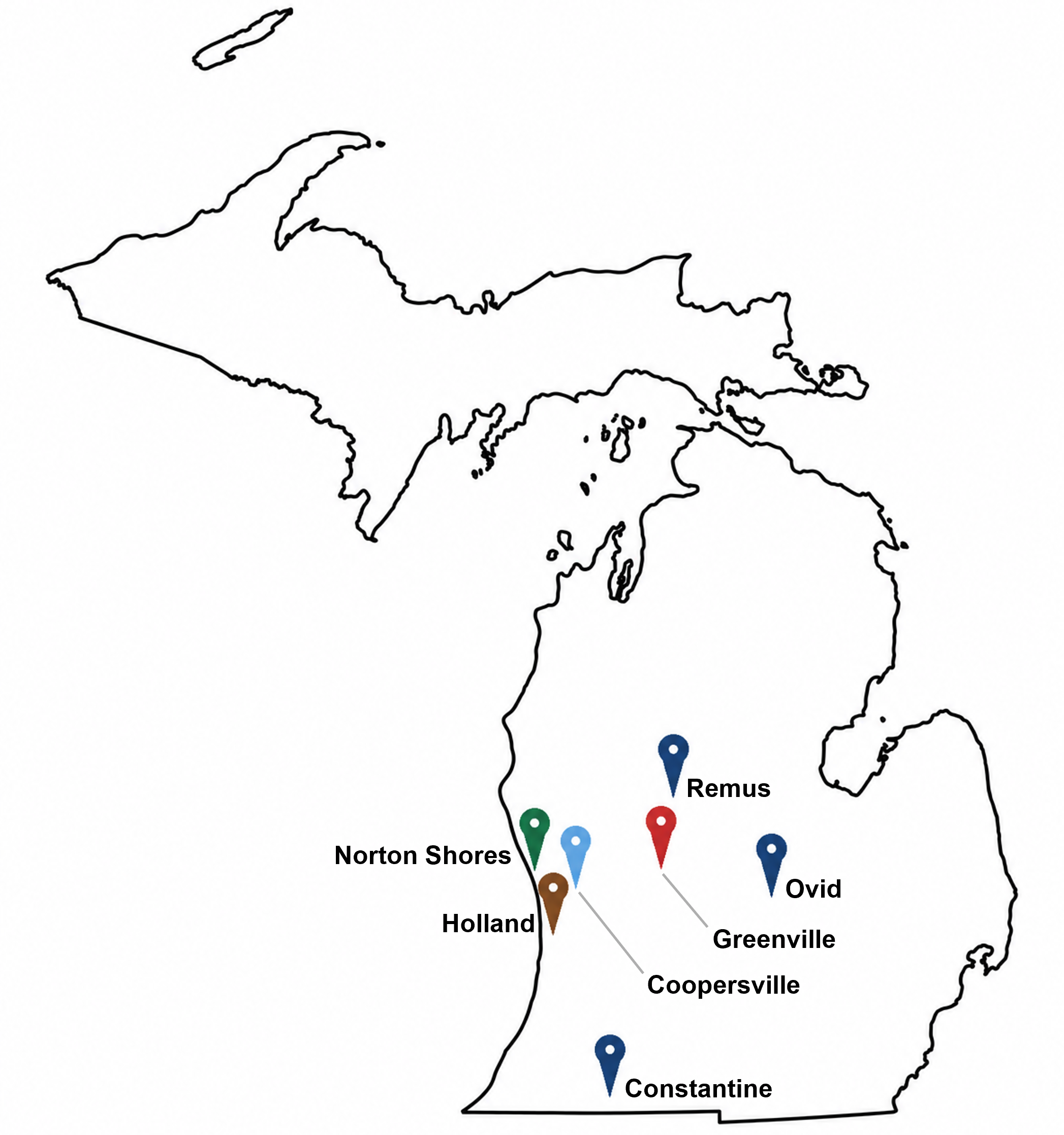
Michigan milk production has been on the rise for years, and it seems processors are taking notice. 2026 marks a big year for Michigan dairy with major expansions underway at Fairlife’s plant in Coopersville, Chobani’s “La Colombe” plant in Norton Shores, Foremost Farm’s plant in Greenville, Hudsonville Ice Cream’s plant in Holland, and Michigan Milk Producers’ supply plants in Ovid, Remus and Constantine. These investments (mapped in Figure 1) have a broad geographic reach in Michigan’s Lower Peninsula.
What is happening?
Much of the new investment seems to be directed at expanding ultrafiltered (UF) milk capacity to meet the needs of the high-protein beverage and cultured products categories. The current expansion in dairy processing capacity in the state is largely targeting Class I and II products, namely high-protein beverage milk, protein shakes, canned dairy-based beverages, ice cream and cottage cheese. The combined value of these ongoing investments is easily over a billion dollars. The expansions also come after years of a steady stream of investment in Michigan dairy, including the opening of the $58 million Foremost Greenville plant in 2018, specializing in the production of condensed milk and bulk cream, and the $470 million MWC plant in 2020, specializing in the production of cheese and whey products.
How did this happen?
Given the precipitous rise in Michigan dairy processing capacity over the last decade, it is logical to ask how we got here. Among the factors attracting processors to Michigan is the availability of raw milk. According to data from the USDA’s National Agricultural Statistics Service (NASS), from 2005 to 2025, milk production on Michigan farms rose from 6.8 billion pounds per year to 12.5 billion pounds per year (Figure 2).

Michigan ranks sixth nationally in total milk production, trailing neighboring Wisconsin by about 20 billion pounds in 2025. That said, Michigan ranks first in the nation for milk produced per cow, highlighting the notable efficiency of Michigan dairies across the national landscape.
How has the industry changed?
Michigan’s fluid milk output reflects a nearly 90% increase in milk production over the last 20 years. This is almost double the growth rate of Wisconsin and Indiana and four times the growth rate of Ohio (Figure 3). The growth in Michigan’s milk production during this period is also reflected in the higher volume of Federal Order 33 (FO33) pooled milk that is sourced from Michigan farms.
FO33, officially known as the Mideast Marketing Area, encompasses large parts of Indiana, Michigan and Ohio, as well as portions of Kentucky, Pennsylvania and West Virginia. In 2005, Michigan farms supplied about 31% of the total producer milk pooled in FO33. In 2025, that figure grew to 51% of the total producer milk pooled in FO33. During that time, according to FO33 data, the number of Michigan dairies contracted nearly 70% from 2,254 dairies in 2005 to 706 dairies in 2025.

The fact that milk production grew in Michigan despite a sharp reduction in the number of dairies is explained by a more than five-fold increase in the volume of milk per farm from 2005 to 2025. Per FO33 data, the average Michigan dairy produces about 1.2 million pounds of milk per month. For comparison, the average Ohio and Wisconsin dairy produces about 400,000 pounds of milk per month, according to data reported by FO33 and FO30, respectively.
The role of milk components
Concurrent with the relative growth in Michigan milk production, milk components have also been on the rise. According to FO33 data, in 2005, as a percentage of total producer milk pounds, butterfat made up 3.84% and protein made up 3.14%. In 2025, that figure grew to 4.50% for butterfat and 3.47% for protein.
This increase in milk components has been partly attributed to advancements in fields such as genetics, nutrition and cow comfort. The larger dairies, which characterize Michigan relative to neighboring states, are best positioned to benefit from these advancements due to the economies of scale in dairy production.
The same economies of scale that have benefited some Michigan producers have also created an economic landscape where it is more difficult for smaller producers to compete. Historically, the high volume of surplus milk in Michigan has forced milk to travel south to milk-deficit regions like Ohio.
Raising milk production without having a local outlet for that milk can cause hauling costs to increase as producers are forced to send their milk out of state. This increase in hauling costs particularly disadvantages smaller producers, who lack the ability of larger producers to spread their higher costs over a greater volume of production.
The increase in the number of larger dairies can also place upward pressure on input prices for smaller dairies, who may have to pay more for feed, land, labor, hauling and veterinary services as they compete with larger dairies for access.
This is not entirely to the detriment of the small family farm, however, since the growth in Michigan milk production and producer efficiency is attracting new processing capacity into Michigan, which could be beneficial for smaller dairies in a variety of ways.
For one, it has provided existing dairies with marketing outlets that did not exist before. In 2005, “Class II Beverages” was not even a category reported by FO33 on its monthly disposition of receipts by pool handlers report. In 2026, after the opening of the Fairlife plant in Coopersville, “Class II Beverages” make up the largest single Class II category, accounting for over 80 million pounds of producer milk utilization per month.
Low fat, no fat, whole?
New trends in how dairy is being consumed are also creating opportunities for Michigan producers. From 2010 to 2025, there was a 560 million pound decrease in the amount of fat-free fluid milk that was being packaged and sold in Order 33. During that same period, however, there was an 890 million pound increase in the amount of whole fluid milk that was being packaged and sold in Order 33.
This trend towards whole milk will likely be amplified by the recently signed “Whole Milk for Healthy Kids Act”, which permits schools that participate in the National School Lunch Program to offer whole milk to their students. Per the biennial Federal Milk Marketing Order container survey, school milk accounts for about 10% in volume of packaged fluid milk products sold per year.
The destigmatization of dietary fat has encouraged an increase in demand for dairy butterfat, which as recently as 2024 was regularly exceeding $3/lb.
Milk protein
Another trend that has been shaking the industry is the surge of consumer interest in high-protein diets beginning in the early 2020s. Whey products, such as whey protein isolate, have featured prominently in this trend with growing demand by retailers and food processors alike, causing record-low whey protein inventories.
By 2022, dry whey prices had reached nearly $0.80/lb. Currently, in 2026, dry whey prices are hovering around $0.65/lb., which translates to an other solids price of around $0.40/lb. This is double what it was for the entire period from 2010 to 2020, adding about $1/cwt. to a producer’s milk check.
The explosive demand for whey has also prompted the opening of new plants and the expansion of existing plants, such as the MWC plant in St. Johns, which produces over 20 million pounds of value-added whey protein powders per year.
The Michigan dairy landscape has shifted dramatically over the last 10 to 20 years. Smaller farms have exited the industry, production and producer efficiency have increased significantly with growth rates outpacing those of neighboring states, supply and demand for milk components have increased, and there has been a surge of investment in expanding processing capacity within the state. While it is too soon to say what the long-term impacts of these shifts will be for remaining Michigan dairies, the industry has proven, if anything, to be resilient. Moreover, demand for dairy products does not appear to be receding any time soon.


