A Co-Produced Roadmap for Future Research at the KBS LTAR Site
DOWNLOADJanuary 12, 2026 - G.P. Robertson, T.C. Ulbrich, B.J. Wilke, B. Basso, H. J. Burrack, T. Butcher, L. Campbell, C. Charles, J.E. Doll, C. Forestieri, N.M. Haddad, R. Heinze, L.T. Johnson, C. Klein, A.N. Kravchenko , D. LaBar , S.T. Marquart-Pyatt , H. Miller, M. Mills, E. O'Halloran, K. Poley, A.Z. Polverento, S. Reed, A.P. Reimer, M. Shaw, A. Smith , C.D. Sprunger , J. Stegink, B. Wickerham and L. Woodke
 Print
Print Email
EmailKBS LTAR Special Publication
January 2026
A Co-Produced Roadmap for Future Research at the KBS LTAR Site
G.P. Robertson, T.C. Ulbrich, B.J. Wilke, B. Basso, H.J. Burrack, T. Butcher, L. Campbell, C. Charles, J.E. Doll, C. Forestieri, N.M. Haddad, R. Heinze, L.T. Johnson, C. Klein, A.N. Kravchenko, D. LaBar, S.T. Marquart-Pyatt, H. Miller, M. Mills, E. O’Halloran, K. Poley, A.Z. Polverento, S. Reed, A.P. Reimer, M. Shaw, A. Smith, C.D. Sprunger, J. Stegink, B. Wickerham and L. Woodke
Affiliations: Michigan State University; ADM; Michigan Farm Bureau; MSU Extension; Michigan Agriculture Advancement; Van Buren Conservation District; Michigan DNR – Barry State Game Area; Michigan Department of Agriculture & Rural Development; Cade Klein Farms & Seed Sales; LaBar Farms; Villa Miller Farms; Michigan DNR; Kellanova; Michigan Corn; Zeeb Farms & Clinton Conservation District; USDA-NRCS; National Wildlife Federation; SKS Farm; Wide Angle Agriculture; The Nature Conservancy; Star of the West Milling.
Long-Term Agricultural Research (LTAR) at the Kellogg Biological Station (KBS) aims to advance the design of row crop systems of the upper Midwest via the Aspirational Cropping Systems Experiment (ACSE), co-produced by scientists and stakeholders to advance the potential for cropping systems to provide important ecosystem services. These include, most prominently, profitable yields, clean water, healthy soil, biodiversity benefits, climate resilience, and social well-being. Stakeholders have expressly stated that they expect KBS LTAR to “bridge the gap between agricultural systems needed by present and future generations.” Long-term, systems-level research that extends from plots to farms is crucial for meeting this challenge.
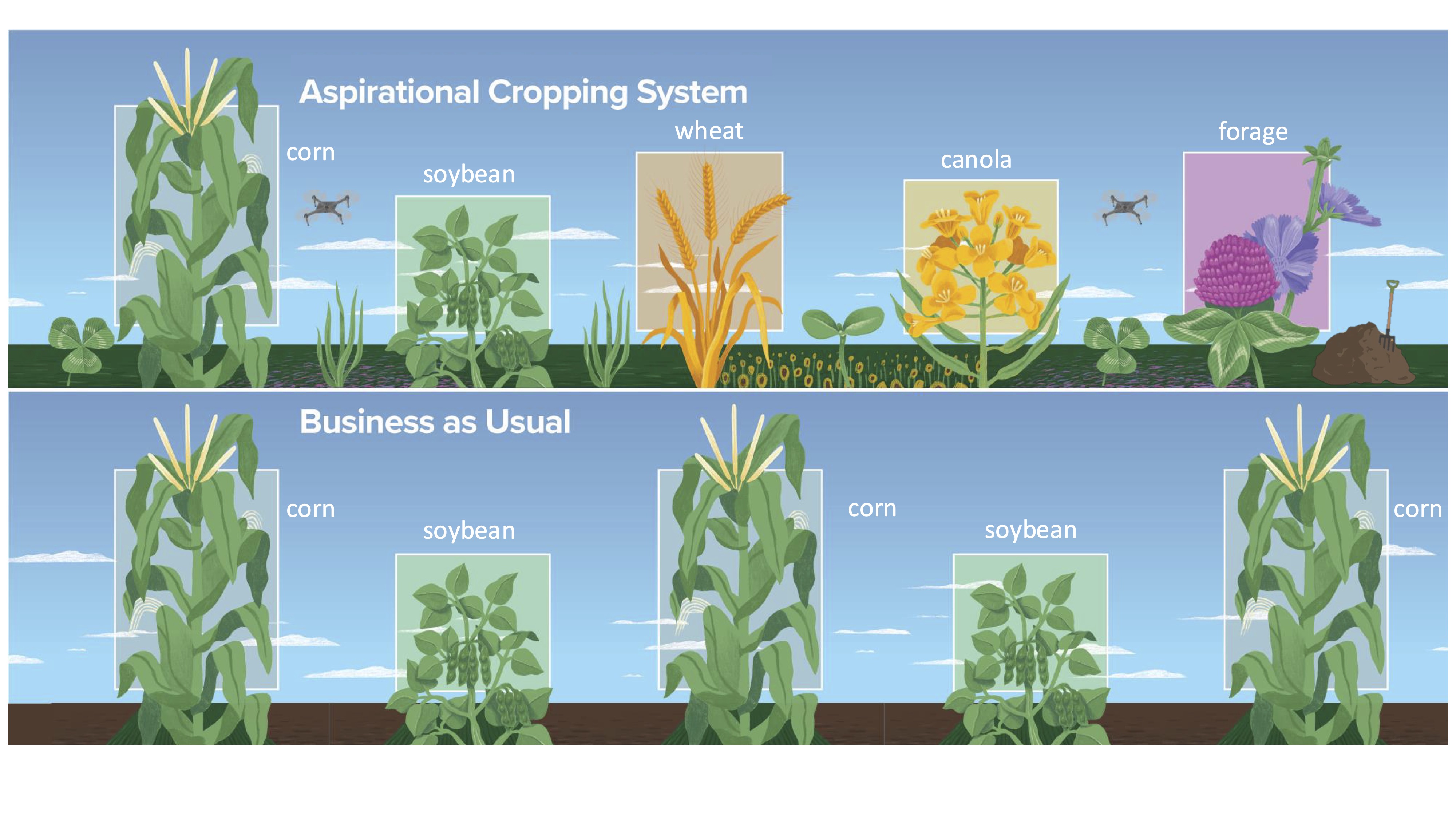
The ACSE, implemented in 2022 at both plot and field scales, is an Aspirational (ASP) vs. Business-as-usual (BAU) cropping system contrast that is part of the LTAR Network’s Common Experiment. The ASP system incorporates many of the principles embedded in regenerative agriculture, an approach to farming that promotes positive environmental, economic, and social outcomes using practices appropriate to individual operations. Currently the ASP is a five-crop rotation that includes cover crops, continuous no-till, precision inputs, and biodiversity conservation patches (prairie strips). Crops include corn, soybean, winter wheat, winter canola, and a multi-species forage mix. Prairie strips are planted only in consistently unprofitable portions of fields. The BAU system, in contrast, reflects prevailing practices in Michigan: a corn–soybean rotation, chisel plowed, without cover crops, and with inputs uniformly applied across fields. Both systems are periodically updated to reflect changing technologies, practices, markets, and social norms.
From the ACSE’s inception in 2022, researchers and stakeholders have collaborated to design, analyze, interpret, and refine the experiment. Stakeholders include all participants in the agricultural value chain, including producers and other agricultural professionals, conservationists both NGO- and agency-based, policy leaders from farm and commodity organizations and government agencies, commodity buyers, and consumer-facing retailers. Following the establishment of the ACSE, collaborative workshops have refined its direction and priorities. For example, an 80-participant metrics workshop in July 2022 deliberated the metrics needed to evaluate success, and a researcher-stakeholder summit in January 2024 identified short- and long-term research priorities, further refined in a summer 2024 joint advisory boards workshop and then the 2025 researcher-stakeholder summit. This whitepaper is the result of these discussions.
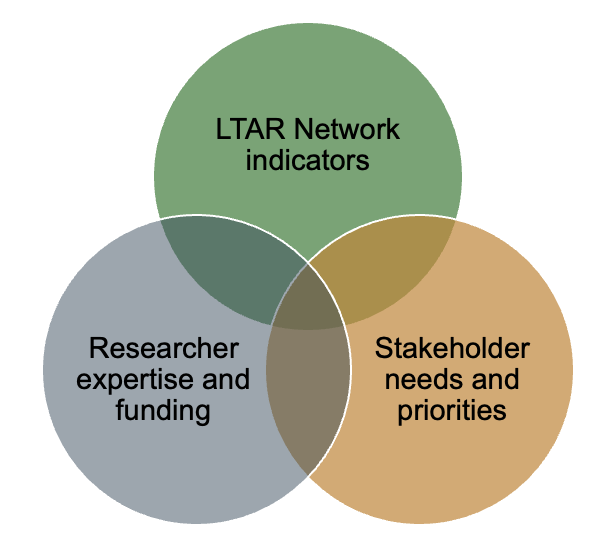
Three considerations provide overarching context for KBS LTAR research priorities. First is participation in the national LTAR Network, which includes multiple crop- and grazing-land sites across the U.S. As part of this broader network, KBS is committed to asking questions and assembling the biophysical and socioeconomic metrics most likely to capture differences between BAU and ASP systems nationally, thereby contributing to the success of U.S. agriculture. Second is a transdisciplinary, cross-sector approach, informed by a wide range of expertise, to test system-level impacts rather than single factors, to ensure relevance to farmers and farming systems of the region, and to conduct long-term research capable of revealing both slow-changing and episodic responses. Third, research is influenced by available expertise and funding.
Based on these influences, the overall portfolio comprises six research themes organized by practice and outcomes to deliver sustained productivity and profit, clean water and air, biodiversity conservation, weather and climate resilience, and social well-being. These themes are: 1) crop diversification; 2) nutrient cycling and livestock integration; 3) tillage management; 4) precision inputs and conservation; 5) soil health; and 6) system integration.
1. Crop Diversification
Diversified crops—more complex rotations that include cover crops—are central to regenerative agriculture and are known to provide benefits ranging from yield stability to pest and disease protection. Despite known benefits, diversifying row crops away from simple corn–soybean rotations in the upper Midwest has been a major challenge. In Michigan, only about 30% of cropland diverges from corn–soybean or continuous corn, and only 10–27% of row crop acreage includes winter cover crops. Diversification is even lower in neighboring states.
Stakeholders and researchers identified four priority questions:
-
What metrics, including profitability and input efficiencies, best identify the ecosystem services delivered by diverse rotations?
-
To what extent does diversification affect the quality of produced feed, food, fuel, and fiber?
-
What information is needed by farmers and policymakers to enhance adoption of cover crops?
-
How can regional markets for diverse crops best be promoted, created, and stabilized?
2. Nutrient Cycling and Livestock Integration
Tight nutrient cycles, wherein nutrients such as nitrogen and phosphorus are conserved and recycled to the greatest extent possible, provide economic savings and protect water and air quality. Water quality is a particular concern of stakeholders, as is the impact of farming on greenhouse gas emissions. Because manure is a major nutrient source in Michigan, livestock integration offers opportunities for efficient nutrient use along with marketing and soil health benefits.
Two major questions emerged:
-
How do different nitrogen sources and their interactions with management affect water quality, nitrous oxide emissions, microbe–plant interactions, soil organic matter, and plant nitrogen availability?
-
How can grazing and manure best be integrated into diverse crop rotations, and what factors most influence their scalability and impact on soil health, water quality, and profitability?
3. Tillage Management
Tillage has well-recognized consequences. While it can accelerate nutrient turnover and warm soils in spring, it also compromises soil structure, increases erosion and nutrient runoff, stimulates soil carbon loss, and contributes to greenhouse gas emissions. No-till management can reduce many of these impacts, but long-term research shows that some benefits—such as improved yields or soil carbon accumulation—may take a decade or more to consistently appear. Resuming tillage can quickly reduce these gains.
Stakeholders identified three major questions:
-
To what extent do different intensities and frequencies of reduced tillage affect the long-term benefits of continuous no-till, including profitability?
-
How does continuous no-till affect biodiversity and downstream water quality?
-
How can continuous no-till be implemented within diversified farm approaches and crop rotations?
4. Precision Input Management and In-Field Conservation
Uniform pesticide and fertilizer applications treat entire fields the same, despite subfield variability in weed pressure and yield potential. Precision technologies allow inputs to be applied only where needed, offering cost savings and environmental benefits. In persistently low-yielding areas, converting land to prairie strips may make more economic and ecological sense. Prairie strips comprised of diverse perennial forbs and grasses can support pollinators, beneficial insects, and grassland birds.
Three questions were identified:
-
What is the short- and long-term return on investment for variable-rate fertilizer and pesticide applications?
-
What are the biodiversity benefits and potential drawbacks of precision conservation, including spillover impacts on adjacent cropland?
-
What information do farmers and policymakers need to advance adoption of precision conservation?
5. Soil Health
Healthy soils are foundational to regenerative agriculture and essential for achieving economic and environmental benefits. Soil health combines physical, chemical, and biological attributes conducive to vigorous crops and long-term success. Common indicators include soil organic carbon, aggregate stability, and soil respiration. Biological attributes such as nematode community structure and chemical indicators like permanganate oxidizable carbon show promise, but consensus on integration of early indicators is lacking. Farmers recognize soil health’s importance but often express uncertainty about how best to manage for it.
Priority questions include:
-
Which soil health indicators most quickly and reliably predict improved ecosystem function to inform management decisions?
-
How do different management practices interact to benefit or harm soil health in different Michigan soils?
6. System Integration
Weaving together practices to achieve desirable productivity, economic, social, and environmental outcomes requires a systems-level understanding of interactions. Implementing individual practices such as no-till or cover crops without considering profitability, farmer well-being, or unintended environmental consequences can lead to incomplete outcomes. The combined effects and sequencing of stacked practices remain insufficiently understood, and quantitative models often lack adequate validation data.
A single integrative question captures this need:
-
How do combinations of practices—crop diversity, no-till, manure, precision technology, and biodiversity conservation—impact economic performance and ecosystem service outcomes?
7. Summary
The research priorities outlined above represent a range of topics that KBS LTAR will address through the ACSE, adjacent research projects, social science approaches, and events that facilitate collaboration across the agricultural supply chain. Collaboration with other LTAR sites will help determine how findings scale regionally and nationally.
A database of stakeholder-generated research questions will be updated at future summits. Revisiting priorities in light of new results and emerging challenges will help ensure continued relevance.
8. Acknowledgements
KBS LTAR is supported by the USDA-ARS Long-Term Agroecosystem Research (LTAR) program and by MSU AgBioResearch.