


Search Filters
-
San Jose scale
Adult males are minute, winged insects about 1 mm long and golden brown with a reddish tinge. Scales may be either disk-shaped or oval, and are composed of concentric rings of gray-brown wax radiating from a tiny white knob.
-
Mineola moth (Destructive pruneworm)
Adult is a bluish gray moth that assumes a wedge shape when at rest. It has a transverse broad white stripe bordered by a smaller reddish brown stripe in the middle of the forewings a smaller set of similar bands occur near the posterior edge.
-
Alternaria blotch
The disease primarily affects the foliage, causing circular, necrotic lesions with a light brown interior that later become surrounded by a darker purplish halo.
-
Nectria canker
Cankers are often associated with nodes, often appearing as elliptical sunken areas. Sometimes callus production stops fungal invasion and cankers die by season's end.
-
Brooks fruit spot
Appears as irregular, slightly sunken dark green lesions on immature fruit.
-
Western flower thrips and flower thrips
Western flower thrips and Flower thrips are indistinguishable without a microscope. Adults are slender and yellowish, with short antennae; the wings are long and narrow, and held over the abdomen.
-
Spring cankerworm
The adult male is gray and has winding lines on its forewings the female has stumpy gray wings. The larva is pale green to dark brown with two yellow longitudinal bands on the sides. It moves in a looping inchworm fashion.
-
Cherry fruit flies
The adult cherry fruit fly is somewhat smaller than the house fly, with a yellowish brown head and legs, and white crossbands on the abdomen. The black cherry fruit fly is slightly larger and its abdomen is entirely black.
-
Cigar casebearer
Adult is dark gray with fringed wings. The small yellowish larva of the cigar casebearer has a black head and builds and hides in a cigar-shaped shelter that it carries with it while feeding or attaches to leaves and branches of apple trees.
-
Lady beetles
Adults are oval and convex in shape, often brightly colored (e.g., orange-red or yellow) and usually with black spots or marks on their wing covers, sometimes with a checkerboard appearance.
-
Hawthorn dark bug
The young adult is black with red wing markings, which disappear a few days after it metamorphoses into an adult.
-
Apple rust mite
The vermiform adult has two pairs of legs at the front of its body. Brownish yellow in color, they are invisible to the naked eye, requiring a minimum magnification of 15X to be observed.
-
Pear thrips
Adult is slender and brown, with short antennae and a swelling behind the head; the wings are long and narrow, with fringes of long hairs.
-
Pesticide Applicator Training
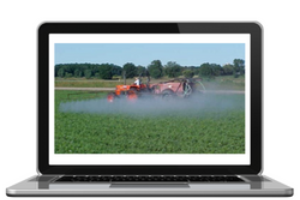
This course is designed for those who are studying to take the Michigan Department of Agriculture and Rural Development (MDARD) Restricted Use Pesticide (RUP)Exam or for those who need a refresher on safe pesticide handling. The course material follows the National Pesticide Core Manual. Those who complete the course can receive 12 RUP credits.
-
Preschool-Grade 1
Tollgate Farm and Education Center offers a variety of programs for children in preschool, kindergarten, or first grade to explore the seasons at the farm!
-
Pollinator Protection for Pesticide Applicators
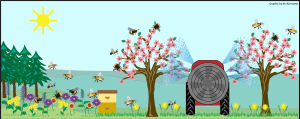
This self-paced, online course about pollinators is directed toward pesticide applicators with a focus on crops pollinated by honey bees.
-
Integrated Pest Management Academy
The Desire to Learn Integrated Pest Management (IPM) Academy is an interactive, online program designed to provide a comprehensive and convenient online learning experience. Current topics include an introduction to IPM, plant science, soils 101, natural enemies, conserving pollinators, Enviroweather and scouting.
-
Using the 2025 Michigan Apple Cost of Production Study
Published on November 14, 2025
This is a recording of the “Using the 2025 Apple Cost of Production Study” webinar held on November 13, 2025. During the video, we look at per bushel and per bin costs, break-evens for both semidwarf and high density plantings, and how to adjust the results to your farm's specific numbers. This webinar was part of the Farm Policy & Risk Management series.
-
Annual spotted wing drosophila population variability in Michigan
Published on February 6, 2020
Dr. Julianna Wilson of the Department of Entomology at Michigan State University talks about spotted wing drosophila populations in Michigan.
-
Spotted wing drosophila insecticide efficacy and management programs
Published on February 6, 2020
Dr. Larry Gut of the Department of Entomology at Michigan State University talks about insecticide efficacy and management programs for spotted wing drosophila in cherries.

 Print
Print Email
Email